
Jewellery Hallmarks and Assay Reports: How to Read the Evidence
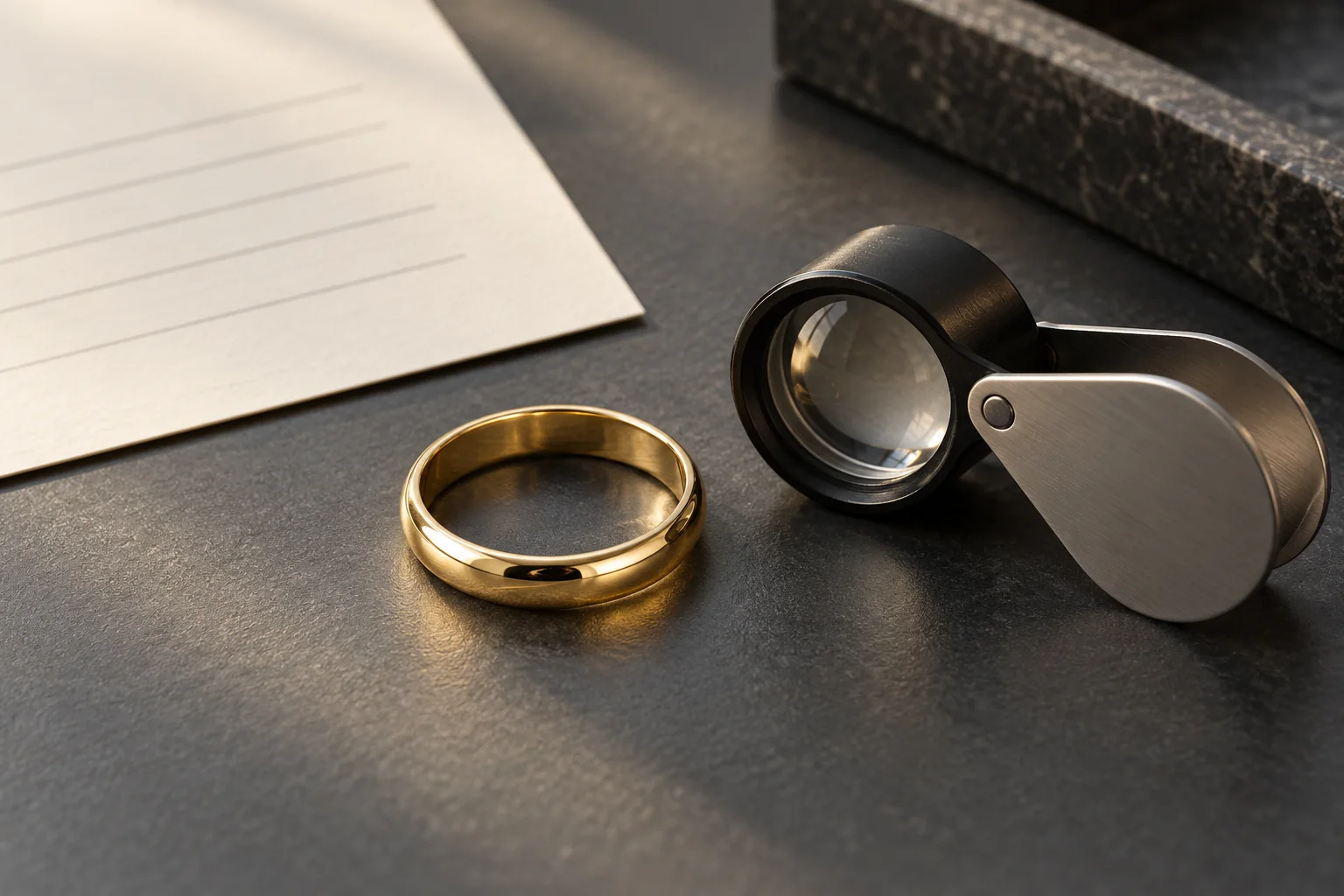
A small number inside a ring can be easy to overlook. So can the difference between a mark on the metal and a laboratory document supplied with it. Reading both carefully helps you understand what has been claimed, who checked it and which questions still need an answer.
Start with three separate details: the identity of the metal, its stated fineness and the evidence connecting that description to the particular item. Appearance alone cannot establish all three.
Read the whole group of marks
A fineness mark describes precious-metal content. For example, 750 represents 750 parts per thousand, equivalent to 75%. The surrounding symbols matter because a number alone does not identify the testing organisation or explain the marking system.
The UK provides a useful example. Its complete hallmark has three compulsory components: a sponsor’s mark, a metal-and-fineness mark and an assay-office mark. The sponsor is the person or organisation that submitted the item, which may be a manufacturer, importer, wholesaler or retailer. An optional date letter records the year of hallmarking. These details are explained in the UK government’s hallmarking guide.
For a jewellery buyer, this makes a close-up photograph useful. Ask the seller to show the entire group of marks and explain each element. Keep the photograph with the invoice so you can refer to the item’s description later.
What an assay report adds
Assaying examines metal composition. A laboratory report records the results of specified testing, so its usefulness depends on what was submitted and how it was examined. The Goldsmiths’ Company Assay Office laboratory guide, for example, describes written X-ray fluorescence reports and special assay methods that require a physical sample.
When a report accompanies jewellery, work through a short matching exercise:
- Find the issuing laboratory, report reference and date.
- Check the item description, photograph or sample identification against the jewellery offered.
- Ask which components were tested, particularly for pieces combining different metals.
- Read the method, reported units and any qualifications or limitations.
- If a sample was tested, ask how it was taken and how it relates to the finished piece.
These are useful buyer questions rather than a universal report template. If the connection between a document and the jewellery is unclear, request clarification before treating the result as evidence for that item.
Understand the limits of a quick test
X-ray fluorescence, commonly shortened to XRF, is widely used to assess precious-metal composition. The London Assay Office’s description of its methods explains that XRF is generally non-destructive, while some circumstances require removal of a surface layer or another sampling method.
Surface coatings deserve particular attention. In a 2025 laboratory note on gold-plated gold, GIA documented jewellery whose gold coating affected XRF readings and could make the underlying alloy appear richer in gold than it was. This illustrates why the testing professional must consider construction, coatings and the suitability of the method.
If a seller offers only a screen photograph with a purity number, ask what was tested and whether plating was considered. Avoid filing, acid testing or aggressively polishing a piece yourself: discuss any potentially damaging examination with a qualified professional first.
Identify the relevant country’s system
Hallmarking requirements and recognised marks vary between countries. A UK example should therefore be read in its own context. The Hallmarking Convention describes a Common Control Mark applied by authorised assay offices, alongside other required marks. It also explains that acceptance depends on the importing country recognising the article’s fineness standard.
For a purchase involving different markets, ask which system the item’s marks belong to and which authority can interpret them. A missing or unfamiliar symbol is a reason to investigate the applicable rules, exemptions and item history. It is not enough on its own to settle authenticity.
Keep the evidence in proportion
Precious-metal purity is one part of evaluating jewellery. Ask separately about gemstone identity, repairs, condition and any sourcing claims. Do not read those answers into a fineness mark or a composition result unless the relevant evidence expressly covers them.
The practical goal is a consistent description: the jewellery, its marks, the invoice and any test report should tell a compatible story. For related terminology, read our guide to gold purity and weight, or explore the metals catalogue.