
Industrial Uses of Silver: Solar, Electronics and Beyond
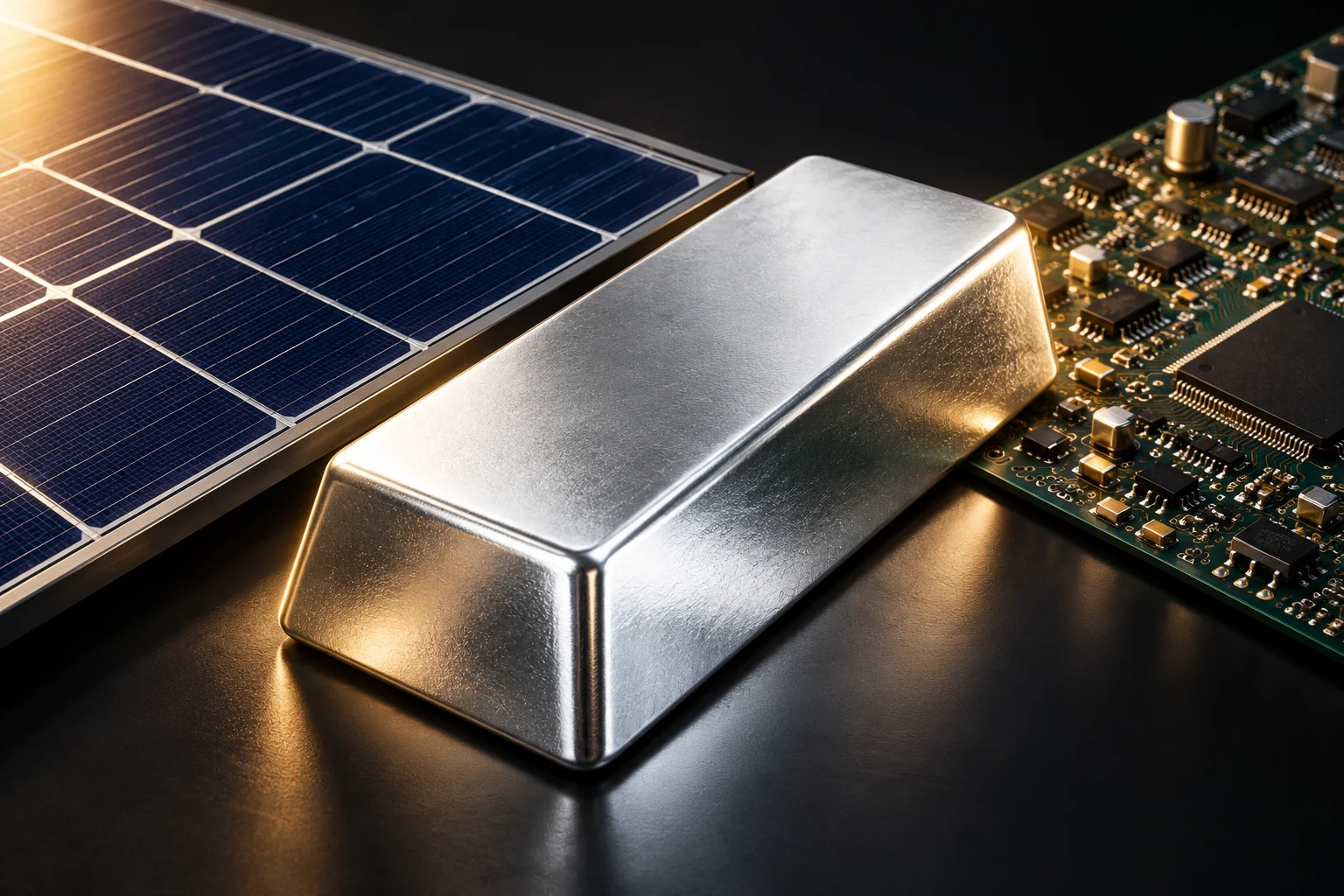
Silver is familiar as a precious metal for bars, coins and jewellery. It also works inside electrical equipment, solar cells and manufactured components. Its industrial value comes from a combination of conductivity, reflectivity and chemical behaviour, with each application requiring a particular material form.
Understanding the main industrial uses of silver helps buyers ask better questions. A manufacturer may need engineered powder, a formulated paste or an alloy component rather than a bullion bar. The specification has to match the production process.
Why silver is useful in industry
Silver conducts electricity and heat exceptionally well. The Silver Institute’s industrial overview describes applications ranging from electrical contacts to conductive inks and solar-cell materials. These properties make small quantities useful in components where performance and reliability matter.
Other properties support different jobs. The Royal Society of Chemistry’s silver profile describes its use in mirrors, electrical contacts, batteries and joining alloys. Silver’s ability to reflect visible light is especially relevant to optical applications.
Engineers still have to consider the whole design. Pure silver is relatively soft and its surface can tarnish. Depending on the application, a manufacturer may use an alloy, composite, coating or formulated material to achieve the required combination of electrical and mechanical performance.
Electrical contacts, switches and power equipment
Electrical contacts make or break a circuit. Their material must perform through repeated operation and under the conditions of the device. Silver-containing materials are used in applications such as relays, contactors and circuit breakers.
This is an area where composition matters as much as the presence of silver. Manufacturer Metalor’s technical description of electrical-contact powders explains how silver is combined with other metals, oxides or refractory materials to produce application-specific properties. Different formulations address requirements such as low contact resistance, resistance to sticking and electrical endurance.
For a procurement team, the practical lesson is to request the approved grade and component specification. Substituting a material solely because it has a higher silver content can miss the properties the equipment actually needs. Changes should go through the manufacturer’s engineering and qualification process.
Solar cells and photovoltaic manufacturing
In many silicon photovoltaic cells, silver-containing contacts help collect the electricity generated by the semiconductor. The U.S. Department of Energy’s manufacturing guide describes screen-printed silver metallization and the connections between cells during module assembly.
The metal is part of the electrical collection system. Cell design, contact geometry and the manufacturing process all affect how it is used. A solar manufacturer therefore needs a compatible metallization material, supported by a technical specification, rather than an interchangeable quantity of silver.
Solar expansion and silver consumption should also be considered separately. More production can increase material requirements, while lower silver loading per cell can reduce the quantity needed for each unit of output. Both effects can operate at the same time.
Conductive inks, joining alloys and catalysts
Silver-based inks create conductive paths on suitable surfaces. The Silver Institute describes uses in printed electronics and radio-frequency identification, or RFID. These applications demonstrate how silver can function as a finely distributed material rather than a visibly solid component.
Silver also appears in brazing and soldering alloys, where the required formulation depends on the joining task. Catalysis is another use: the Silver Institute identifies silver’s role in producing industrial chemicals including ethylene oxide and formaldehyde. These are specialized processes with their own technical and safety requirements. The Institute’s application guide provides an accessible introduction to these uses.
Material efficiency and recycling change the picture
Industrial demand develops alongside engineering improvements. Manufacturers can seek to use less silver per component or substitute another material where performance permits. For example, Fraunhofer ISE’s Kumelle research project, scheduled for May 2024 to April 2027, is developing copper metallization for perovskite-silicon tandem solar cells.
Research into substitution is a reason to examine specific technologies carefully. A laboratory or pilot-line result should not be treated as proof that an entire industry has already switched materials.
Recycling also returns silver to use. Umicore’s e-scrap description explains how precious-metal-bearing electronics can be sampled, assayed and processed to recover silver and other metals. Its published acceptance conditions illustrate why collection, material composition and lot size matter. Recoverable silver is part of a processing system, not an automatic recovery from every discarded device.
What industrial silver buyers should specify
Turn the intended application into a written purchasing requirement. As a practical starting checklist, ask your technical team and supplier to agree on:
- The product form, such as grain, powder, paste, wire or a finished component
- Required composition and any controlled impurities
- Physical characteristics relevant to the process, including dimensions or particle properties
- Lot identification, test results and acceptance criteria
- Packaging, handling instructions and any applicable safety data sheet
- Trial quantities, qualification steps and lead times
Use the Jawharat Al Khalij metals catalog and services page as starting points for an inquiry, then confirm availability and suitability for the exact requirement. Include the application and required material form in your inquiry so availability can be checked against the actual specification.
Silver’s broad range of industrial uses explains why its market deserves careful study. Those uses alone do not establish a future price or guarantee an investment return. For procurement, the immediate priority is a material that meets the application, a clear specification and a dependable verification process.