
Wholesale Jewellery RFQ: A Practical Specification Checklist
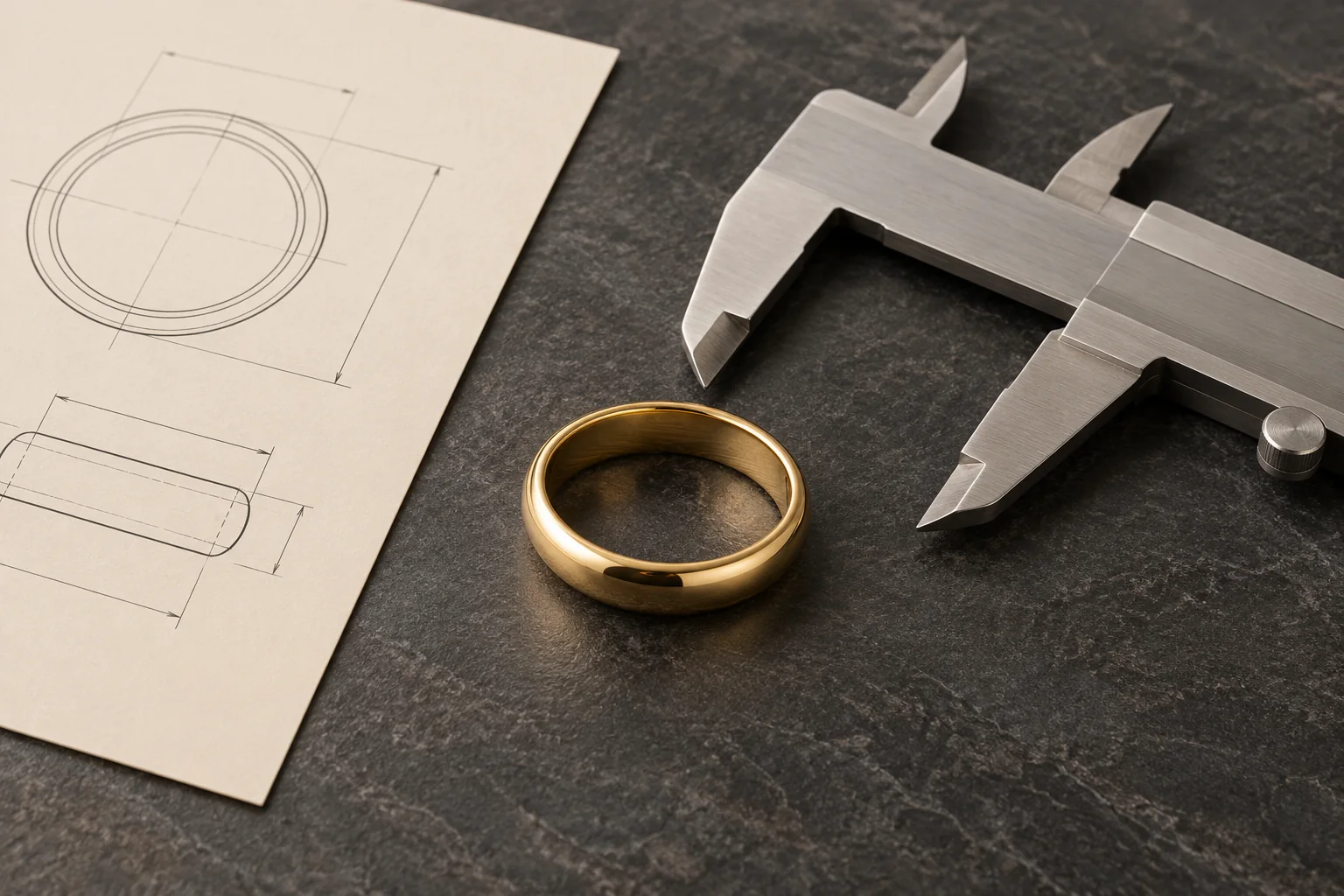
A wholesale jewellery quotation becomes easier to assess when every supplier receives the same description. A photograph and a quantity leave important questions open: how thick is the piece, what does its weight include, and which stones or finishes are acceptable?
A request for quotation, or RFQ, turns those questions into a product specification. The following checklist is a practical starting point for buyers working with a jewellery supplier or manufacturer. Adapt it to the design and ask the supplier to identify anything that needs technical review.
1. Identify every design and size
Give each design a product code and revision date. List the quantity for each size, colour and finish separately. Make clear whether an earring quantity means individual earrings or pairs, and whether a necklace includes its pendant.
Attach dimensioned front, side and detail views where available. State the measurement unit, normally millimetres for small features, and identify the ring-sizing system. For chains and bracelets, explain whether the stated length includes the clasp. For pendants, distinguish the body dimensions from the overall dimensions including the bail.
Mark the features that matter most: shank width and thickness, stone-seat dimensions, chain-link profile, clasp type or the opening through a bail. A rendering can communicate appearance, but technical details still need review. GIA’s discussion of jewellery design explains why translating an image into a manufacturable piece requires knowledge of materials, dimensions, tolerances and wearability.
2. Specify the metal and finish
Record the metal, numerical fineness and colour, followed by any required alloy designation. For example, 18-karat gold corresponds to 750 parts gold per thousand, or 75% gold. The World Gold Council’s jewellery guide explains how fineness and caratage describe gold content.
Fineness alone leaves the remaining alloy composition unspecified. Ask for the proposed alloy and state any material restrictions that your product requires. Describe plating separately, including its material, location and any agreed thickness requirement. Distinguish a polished, brushed, textured or mixed finish, ideally with a labelled reference sample.
Ask the supplier to identify separately any components with different materials, such as a clasp mechanism or decorative insert. This makes the description more useful than a single metal label applied to the whole item.
3. Separate unit weight from order weight
Use clearly named weight fields:
- Finished item weight: the complete piece, stating whether stones and non-metal components are included.
- Metal-alloy weight: the weight of the specified alloy, where the supplier can provide it separately.
- Stone weight: individual and total gemstone weights, with the unit stated.
- Order total: the quantity multiplied by the relevant unit-weight basis, with packaging recorded separately.
Identify whether each figure is a design estimate, a target range or a measured sample result. Different ring sizes may need different weight estimates. For illustration, 100 pieces at an estimated 4.0 grams each give an estimated 400 grams on that same weight basis; this calculation does not establish the final shipment weight.
For gemstones, one metric carat equals 0.20 gram. GIA distinguishes gemstone carat weight from gold karat fineness. Write the field names in full to prevent the two meanings being confused.
4. Describe stones individually and as a set
List the gemstone material, count, shape, dimensions and intended setting for each position. State whether you require natural or laboratory-grown material, and request treatment information. For diamonds, specify the quality information required rather than relying on an undefined description such as “premium stones.”
For matched pairs or multi-stone designs, describe the desired consistency in colour and appearance. Ask whether stated weights refer to each stone or the total for the piece, and whether they are measured or estimated.
The importance of clear material descriptions is illustrated by GIA’s laboratory submission policy, which calls for disclosure of known or suspected treatments and laboratory-grown material. For your RFQ, request the relevant descriptions and any agreed reports in writing.
5. Agree tolerances, samples and review points
A tolerance defines the permitted variation around a target. Ask the supplier to propose achievable limits for critical dimensions, unit weight and finish consistency. There is no single tolerance in this checklist that suits every jewellery design.
Specify how dimensions will be measured and whether checks apply before or after polishing, plating and stone setting. Label photographs used for appearance approval and record the approved sample’s reference. If a drawing changes, issue a new revision and ask the supplier to identify any effect on the quotation.
Finally, request a response against the same product codes. Ask for quantity assumptions, sample costs, production timing, packing details, quotation validity and any exceptions to the specification. Keep unresolved points visible instead of allowing a blank field to become an assumption.
For wider precious-metal purchasing context, read our guide to sourcing documentation. A concise, complete RFQ gives both buyer and supplier a clearer starting point for discussing the actual product.