
Yellow, White and Rose Gold: Colour, Karat and Everyday Wear
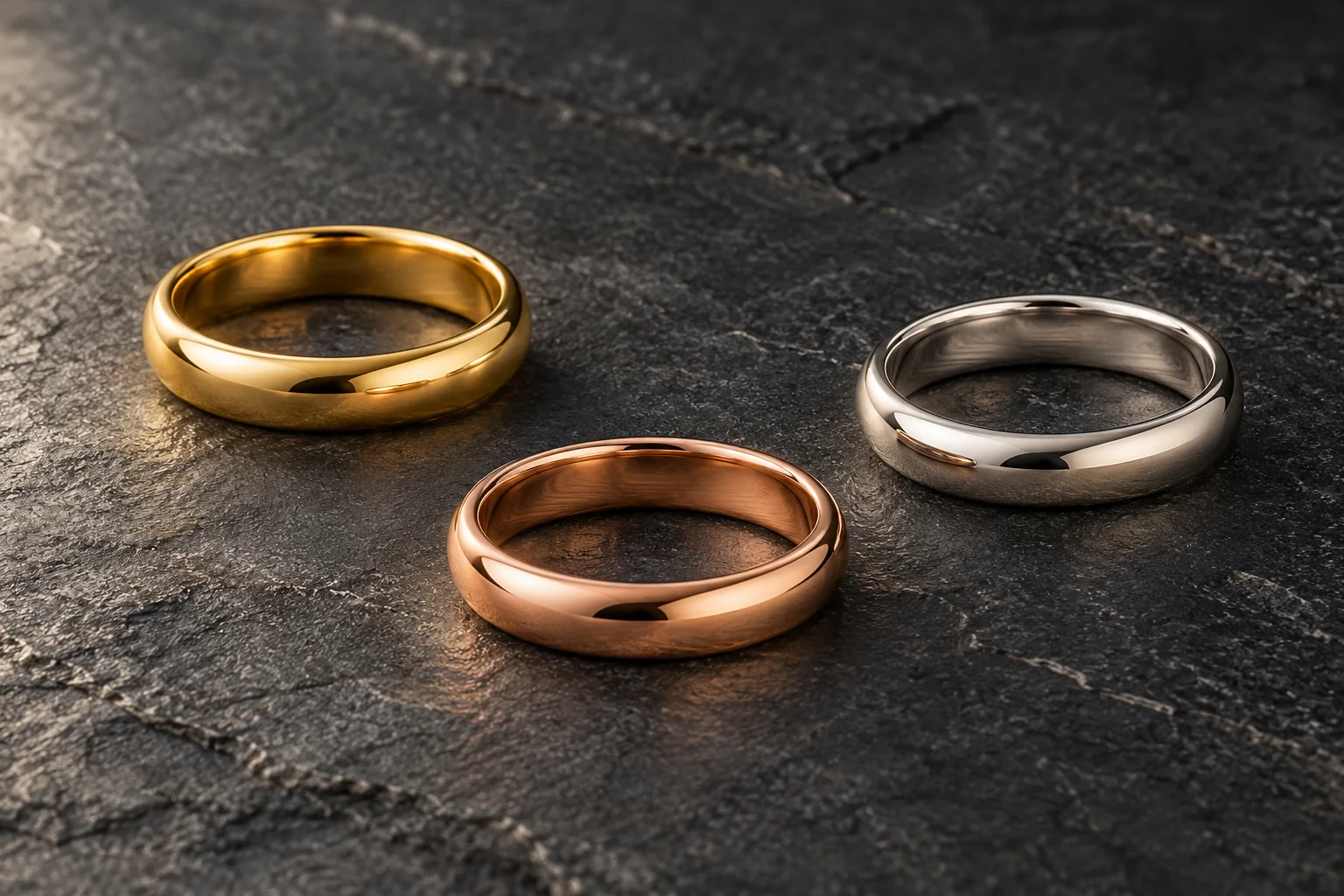
Yellow, white and rose gold can share the same gold content while looking very different. The colour comes from the alloy recipe and, in some jewellery, a surface finish. Karat tells you the proportion of gold. Neither detail, by itself, describes how a finished piece will feel or wear.
A useful comparison begins with three questions: what is the fineness, which other metals are present, and how has the jewellery been made and finished?
Karat measures the gold proportion
Gold karatage uses a scale of 24 parts. An 18K alloy contains 18 parts gold out of 24, or 75%, with the remainder made up of other metals. The equivalent millesimal fineness is 750. Fourteen-karat gold is approximately 58.3% gold; 585 is a common commercial fineness mark for 14K jewellery. The World Gold Council’s guide to gold jewellery explains both systems and the role of alloying.
For context, 21K corresponds to 87.5% gold and 22K to approximately 91.7%. Use the actual numerical fineness in the product documentation when precision matters. Local standards and permitted descriptions can differ.
Compare like with like. Two 18K pieces may have the same gold proportion while differing in total weight, alloy composition, construction and workmanship. Equal karatage does not make them identical products.
How the three familiar colours are made
Yellow gold: Jewellery alloys commonly combine gold with metals such as silver, copper and zinc. The exact mixture influences the shade, so two yellow-gold items of the same karat may not be a perfect colour match.
Rose gold: Copper gives these alloys their pink or reddish character, often alongside silver. A rose-gold description covers a range of hues rather than one fixed recipe.
White gold: Gold is alloyed with whitening metals, which may include palladium or nickel. Many pieces are also coated with rhodium to create a bright white surface. Ask whether a particular piece is plated and what colour to expect beneath that finish. GIA explains these differences in its guide to yellow, white and rose gold.
When matching a new ring, chain or pair of earrings to jewellery you already own, compare the actual pieces together. A colour name on a product page gives less information than seeing both under the same light.
Purity is only one part of everyday durability
Pure gold is soft, and alloying changes its working and wearing properties. GIA’s guide to everyday ring materials notes that durability depends on both karat and alloy composition, with 14K and 18K common options for daily wear.
There is no useful shortcut that ranks every finished ring solely by its karat. Ask the jeweller to explain the thickness of the band, whether the construction is hollow or solid, and whether the design suits your intended use. For stone-set jewellery, include the setting in that conversation. A delicate appearance may be a deliberate design choice, but you should understand the care it requires.
Think about where the item will be worn. A ring used every day, an occasional pendant and a broad ceremonial bangle present different practical questions. Tell the seller about the intended use before narrowing the choice by colour or purity.
Plan for the finish you prefer
Rhodium plating can wear over time, allowing the underlying white-gold colour to become more visible. Replating may be needed if you want to retain the original bright finish. Ask what service is available and what it costs, without assuming every wearer will need the same schedule.
Request care instructions for the complete piece. GIA’s jewellery-care guidance warns that chlorine and other household chemicals can damage alloys or gemstones. Some treated and delicate gems also need special cleaning precautions. A routine suitable for a plain metal band may be unsuitable for a ring containing pearls, porous gems or treated stones.
A short comparison checklist
- Record the karat and numerical fineness.
- Ask about the alloying metals, particularly if you have a known metal sensitivity.
- Confirm whether the colour includes plating or another coating.
- Compare the actual weight, dimensions and construction.
- Ask about cleaning, refinishing, resizing and repair options.
- Keep the final description and care advice with your invoice.
Choose the combination that suits your preferred appearance and intended use, with a clear description of what you are buying. Our guide to gold purity and weight explains related measurement terms. You can also explore the metals catalogue.