
Gold Chain Clasps: Types and Practical Wear Checks
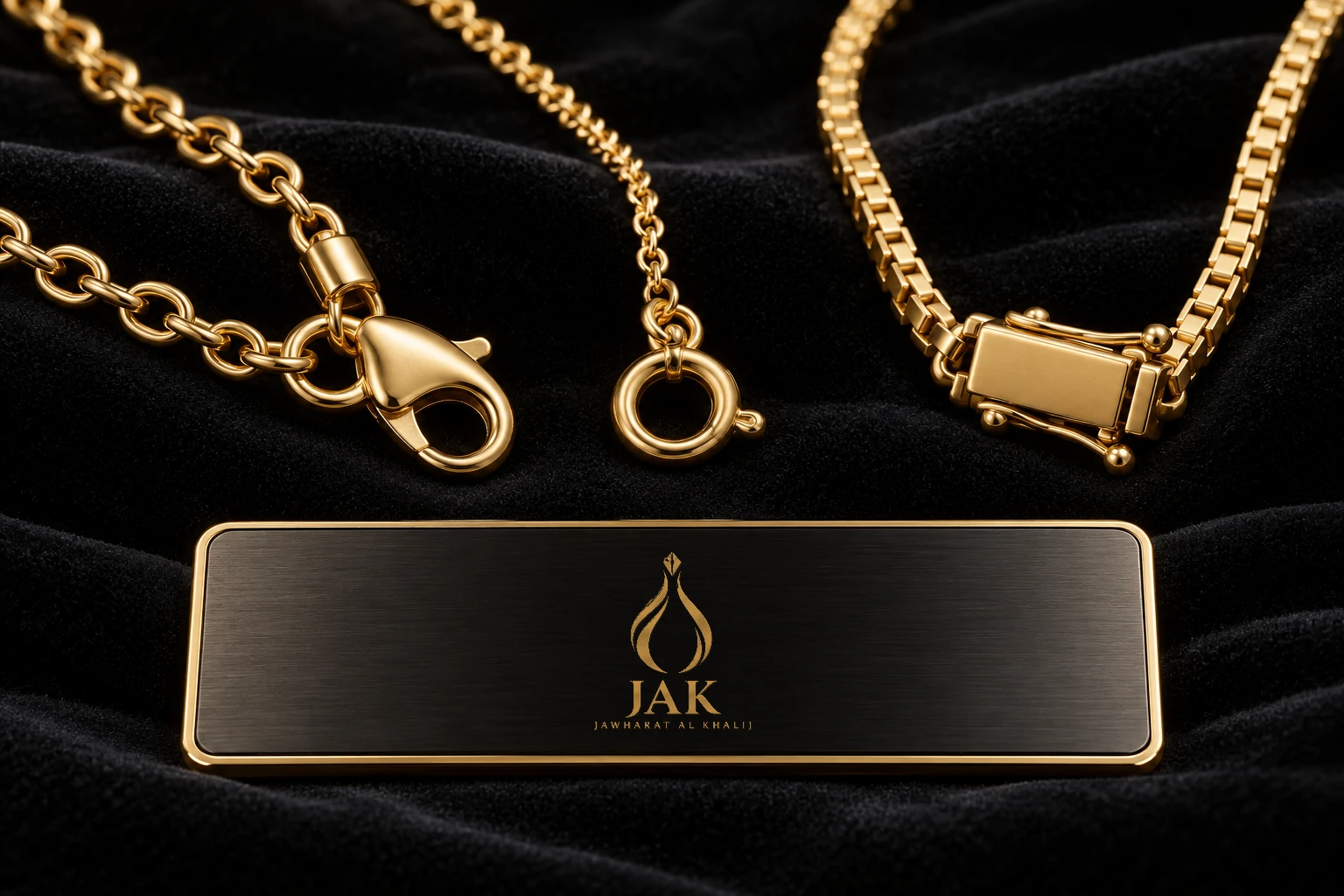
A chain’s fastening is a small system: the clasp, the receiving ring, the connector at each end and sometimes a secondary safety catch. Inspecting only the part you open can miss a problem elsewhere. A clasp that closes neatly cannot compensate for an end ring that has opened or a connector that has become distorted.
The best clasp choice is also personal. A fastening should suit the chain and be manageable with your own hands. Start with how each mechanism works, then check the particular example rather than relying on a reputation attached to its name.
Spring ring: a circular body and sliding bolt
A spring-ring clasp has a small lever that retracts part of its circular enclosure. Releasing the lever allows the internal spring to return the bolt to its closed position. Jewellery supplier Otto Frei describes this construction, including the internal spring and attached connector.
For a wear check, operate the lever normally over a soft surface. The bolt should return fully without your pushing it into place. Look at the closing point after attaching the chain’s receiving ring: a ring caught in the opening can prevent complete closure.
If a tiny tab is difficult to manage, ask to try another size or design. Difficulty fastening a necklace behind your neck is a usability concern even when the mechanism itself functions correctly.
Lobster clasp: a spring-operated gate
A lobster clasp usually has an elongated or shaped body with a lever-operated gate. Rio Grande’s component guidance describes the spring-operated closure that retains the receiving ring until the release is operated.
Check that the gate returns to its resting position and that the lever is neither visibly bent nor obstructed. Hold the body while operating it; avoid twisting the chain to gain leverage. A gate that stays partly open, hesitates repeatedly or needs to be nudged shut deserves professional attention.
Do not assume that every lobster clasp is stronger than every spring ring. Dimensions, workmanship, condition and the way the clasp connects to the chain all affect the finished assembly. Compare actual pieces, not only names.
Box clasp: primary tongue and secondary safety
A box clasp uses a spring-tensioned tongue that enters a housing and engages inside it. Some designs have an additional side catch. Rio Grande illustrates this arrangement in its box-clasp component description.
Close the main mechanism as its maker intends, then engage any safety catch. Neither an audible click nor a closed secondary catch alone proves that the tongue is properly seated. Look for complete engagement without forcing the parts together.
If the tongue will not hold, a safety catch is not a substitute for repair. Equally, do not keep wearing a piece with a damaged safety simply because the main closure seems adequate. Ask the jeweller to inspect both functions and demonstrate the correct release sequence.
Toggle clasp: check how the bar sits
A toggle clasp uses a bar passed through a ring and turned across it. It does not operate like a spring-loaded gate. The assembled dimensions and the way the piece hangs matter, so ask to see the clasp both laid flat and in its intended wearing position.
Check that the bar passes through fully and then rests across the ring, rather than remaining partly inserted. Tell the jeweller if it repeatedly slips back through during normal movement. Do not modify the bar or squeeze the ring smaller yourself.
There is no universal clasp ranking that replaces checking suitability for the actual necklace or bracelet. The Rio Grande clasp catalogue shows how many fastening families and dimensions exist, including hook, screw, magnetic and fold-over designs.
Inspect the connections as well as the mechanism
With the chain supported on a cloth, follow the fastening assembly from one chain end to the other. Look for a newly visible opening in a connector, a ring pulled out of shape, a split end fitting or a sharp edge that was not there before.
A visible joint line is not automatically a defect; some components have intentional construction seams. A gap, distortion or recent change is the reason to seek assessment. Do not pull hard to prove a connection is strong. That turns observation into a stress test and can damage a weakened part.
Our hollow and solid chain construction guide covers a different question: how the chain body is made. Neither construction description establishes the condition of its fastening.
Use a short routine before wearing
- Work over a clear, soft surface where a dropped piece can be found.
- Check the clasp and both end connections in good light.
- Operate the intended release without force and confirm full closure.
- Confirm that the receiving ring is captured inside the clasp.
- Engage any safety feature and stop if a component behaves differently.
If something sticks, avoid oil, glue, household pliers or repeated force. Store the piece separately and explain the symptom to a jeweller. Ask whether the mechanism, connecting ring or complete assembly needs attention, and whether a replacement will change the finished length. A dependable fastening is one that suits the whole piece and that you can close correctly every time.